How to Spot a Product Opportunity Before Writing Any Code
Most products don't fail because the code was bad. They fail because the problem wasn't painful enough for anyone to change what they already do. The good news is that you can test most of this before an engineer writes a single line.
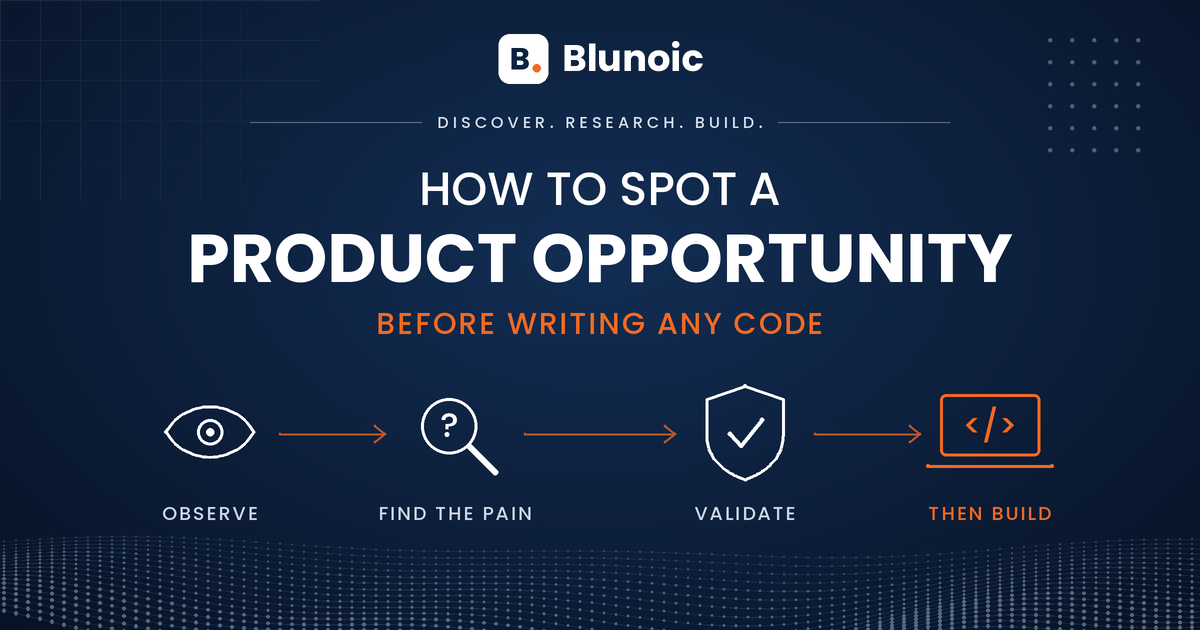
Start with a problem, not an idea
Ideas are cheap and feel exciting. Problems are specific and uncomfortable, which makes them far more useful. An idea says, "What if there was an app for this?" A problem says, "This person loses two hours every week doing this by hand."
When a new idea comes up, rewrite it as a problem statement before you do anything else. If you can't name a real person who has the problem, you don't yet have an opportunity. You have a guess.
The one-sentence test
For [a specific kind of person] who [has a specific problem], we could [deliver a specific outcome], unlike [how they cope today].
If you can't fill in every bracket with something concrete, keep researching.
Watch for workarounds
The strongest signal of a real problem is that people have already built their own fix. Look for:
- Spreadsheets that have grown into tools nobody planned
- Copy-and-paste steps between two or three systems
- Shared inboxes, chat threads or paper forms standing in for software
- A "the person who knows how it works" on every team
A workaround means the problem is frequent enough and painful enough that someone spent time on it. That is worth far more than a person telling you, "Yes, I'd probably use that."
Listen where people complain
People are honest when they are frustrated and not being interviewed. Read the places where frustration collects: product reviews of existing tools, community forums, support threads, public Q&A sites and the comments under industry articles.
You are not looking for feature requests. You are looking for repeated frustration: the same complaint, in different words, from different people. One angry post is an anecdote. Twenty similar ones are a pattern.
Write down the exact words people use. They will become your research notes, your interview questions and, later, your product copy.
Find who feels it, and how often
A problem can be real and still be a poor opportunity if it is rare or spread thinly across too many different people. Two questions help narrow it down:
- Who feels it most? Pick one group and describe their day. Narrow beats broad at this stage.
- How often does it happen? A daily annoyance builds a habit. A once-a-year problem has to be very expensive to justify a product.
The best early users are people for whom the problem is frequent, painful and currently handled badly. Start with them and expand later.
Check what the problem already costs
Every problem has a cost, even when no one has written it down. It can be money, hours, errors, missed deadlines or lost customers. Ask what the problem costs today, and who is paying.
Also check whether people already spend money on it: software subscriptions, consultants, extra staff or agencies. Existing spend shows that the problem has a budget. If nobody pays for any solution and nobody has built a workaround, the problem may simply not matter enough.
Test the idea without code
Once a problem looks promising, test it with the cheapest tools you have. None of these need engineering:
- Problem interviews. Talk to five to ten people from your target group. Ask about the last time the problem happened, what they did and what it cost. Avoid pitching.
- A simple landing page. Describe the outcome in plain words and add a waitlist form. See who signs up and from which channels.
- A clickable prototype. Design the main screens and walk people through them. Watch where they hesitate.
- A manual version. Deliver the result by hand for a few people. If they value it when it's manual, software will make it better. If they don't, software won't rescue it.
Treat what people do as stronger evidence than what they say. A signup, a booked call or a pilot request is worth more than a compliment.
Score the opportunity
Before you commit, score the idea honestly against a few simple questions. Rate each from 1 (weak) to 5 (strong).
| Question | What a strong answer looks like |
|---|---|
| Frequency | The problem happens daily or weekly, not once in a while. |
| Pain | It costs real time, money or stress, and people talk about it unprompted. |
| Workaround | People already patch it with spreadsheets, manual steps or several tools. |
| Spend | People already pay, in money or staff time, to deal with it. |
| Reach | You can name where to find these people and how to reach them. |
| Fit | Your team has the skills and patience to solve it better than others. |
This is a thinking tool, not a formula. If several answers come out weak, you haven't found a dead end. You've learned where to look harder before spending money on development.
Know when to walk away
Finding out early that an idea is weak is a win, because it saves months of work. Be ready to pause or drop an idea when:
- People agree the problem exists but nobody has tried to solve it
- You can't find five people willing to talk about it
- The only people excited are friends and family
- The solution depends on changing a habit that nobody wants to change
Dropping an idea doesn't waste the research. Notes from one dead end often point toward a better problem nearby.
How we approach it at Blunoic
Our approach follows three words: Discover. Research. Build. Spotting an opportunity belongs entirely to the first two. We explore a problem space, check the evidence and validate demand before any product is designed or developed. Engineering begins only once the problem is clear enough to deserve it.
You can read more about how we move from research to real products in From research to real products, or see the stages on our How we work page.
Frequently asked questions
What is a product opportunity?
A product opportunity is a real, frequent and costly problem that a specific group of people has, that is handled badly today, and that you are able to solve better. An idea only becomes an opportunity when you can name who has the problem and what it costs them.
How can I validate a product idea without writing code?
Run five to ten problem interviews, put up a simple landing page with a waitlist, walk people through a clickable prototype, or deliver the result by hand for a few people. Each of these tests demand for very little money.
How many people should I interview to validate a problem?
Start with five to ten people from your target group. Ask about the last time the problem happened, what they did and what it cost them, and avoid pitching your idea. Repeated patterns across those conversations matter more than any single answer.
What are the strongest signs that a problem is worth solving?
People have already built workarounds such as spreadsheets or manual copy-and-paste steps, the same complaint shows up from many different people, the problem happens daily or weekly, and people already spend money or staff time on it.
Why are workarounds a good signal?
A workaround shows the problem is frequent and painful enough that someone spent their own time fixing it. That is much stronger evidence than a person saying they would probably use a new product.
How do I score a product opportunity?
Rate it from 1 to 5 on frequency, pain, workaround, spend, reach and fit. Several weak scores do not mean a dead end; they show where to research harder before spending money on development.
When should I walk away from a product idea?
Pause or drop an idea when nobody has tried to solve the problem, you cannot find five people willing to talk about it, only friends and family are excited, or the solution depends on a habit nobody wants to change.
When should I start building the product?
Start building once the evidence is clear: you know who has the problem, how often it happens, what it costs, and people have shown real interest through signups, booked calls or pilot requests rather than compliments.
Have a problem worth exploring?
If you're weighing a product idea and want a second pair of eyes on the research, we'd be glad to talk.
Contact Blunoic See how we work