What a Good B2B Technology Partnership Looks Like: Ownership, Rights and Trust
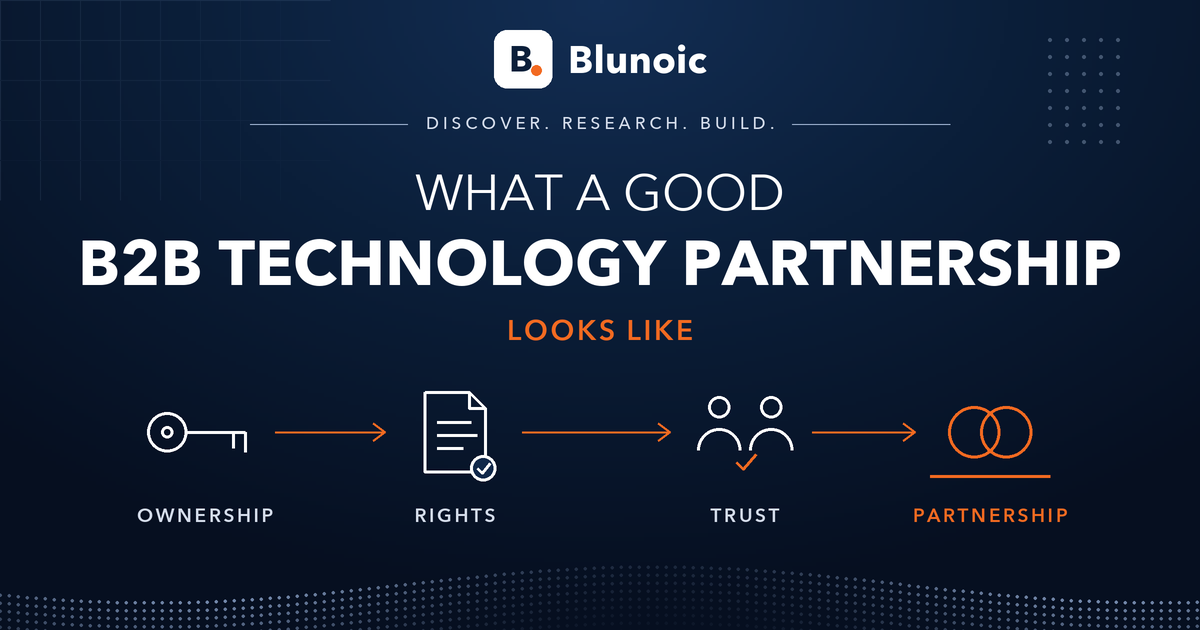
The best B2B technology partnerships feel simple from the outside. Underneath, both sides agreed early on who owns what, what each is allowed to do, and how they'll keep each other informed. Here is what that looks like in practice.
Why technology partnerships go wrong
Most B2B technology partnerships don't fail because the technology didn't work. They fail because two businesses had different pictures of the same deal. One side thought it was buying a product. The other thought it was lending one. Nobody wrote down who owned the improvements, and nobody asked what would happen if the partnership ended.
The fix is not a longer contract. It is a few clear conversations, held early, about three things: ownership, rights and trust.
Start with a shared problem and outcome
A partnership should exist because both sides want the same problem solved, not because a deal looked good on a slide. Before talking terms, agree on:
- The problem. Whose problem it is, how often it happens and what it costs today.
- The outcome. What will be measurably different in six or twelve months if this works.
- The split. What each side brings: technology, data, customers, domain knowledge or delivery capacity.
The one-paragraph test
If both teams can't describe the partnership's purpose in the same short paragraph, you aren't ready to discuss ownership or price. Write that paragraph together first.
Ownership: decide who owns what, before work starts
Ownership is the most common source of conflict, and the easiest to prevent. Separate it into four buckets and agree on each one in writing:
| What | The question to answer |
|---|---|
| Background IP | What did each side own before the partnership? List it, so it's never confused with new work. |
| Foreground IP | Who owns code, designs or models created during the partnership? One side, both, or split by area? |
| Improvements | If one side improves the other's technology, who owns that improvement and can it be used elsewhere? |
| Data | Who owns the data that flows through the solution, and who may use it, for what, and for how long? |
None of these answers is right or wrong in general. What matters is that both sides agree on them before anyone writes a line of code, while goodwill is high and nothing has been built yet.
Rights: scope the licence clearly
When one business licenses technology to another, ownership stays where it is and rights are granted instead. A good licence is specific. It should answer:
- What is licensed. The exact software, components, models or documentation.
- Permitted use. Internal use only, embedding in the partner's own product, or offering to the partner's customers.
- Territory and exclusivity. Where it can be used, and whether anyone else may receive the same rights.
- Duration and renewal. How long the licence lasts and how it renews or ends.
- Sublicensing and modification. Whether the partner can pass rights on, change the code or build on it.
- Support and updates. What maintenance, security fixes and new versions are included.
Vague licences feel friendly at the start and cause disputes later. Specific ones feel formal at the start and make everything after easier.
Data and security: share the responsibility explicitly
Technology partnerships almost always involve data, and data brings obligations. Agree who is responsible for storing it, protecting it, responding to incidents and meeting privacy rules in each region you operate in. Decide which security standards apply, how access is granted and removed, and how quickly each side must tell the other about a problem.
Security works best when it's designed in from the first conversation, not added after launch. That's as true for a partnership as it is for a product.
Trust: built in the everyday, not in the contract
A contract sets the boundaries. Trust is what makes the work inside them go well. It comes from small habits, repeated:
- One owner on each side who can make decisions and is accountable for them.
- A steady rhythm of reviews, with the same shared measures of success each time.
- Bad news early. A delay shared in week two is a planning problem. Shared in week ten, it's a trust problem.
- Decisions written down, briefly, so nobody has to rely on memory.
- Openness about limits: what the technology can't do yet, and what neither side knows.
Plan the exit at the start
It can feel odd to discuss the end of a partnership before it begins. In practice it's a sign of maturity, and it often makes agreement easier because both sides feel protected. Decide:
- How long any licence continues after the partnership ends, if at all
- How data is returned, transferred or deleted, and by when
- What transition support is offered so customers aren't left stranded
- Which obligations survive, such as confidentiality
A checklist before you sign
Before committing, both sides should be able to answer "yes" to each of these:
- We agree on the problem, the outcome and how we'll measure it.
- Background IP is listed, and ownership of new work is agreed.
- The licence scope covers use, territory, exclusivity, duration and modification.
- Data ownership, security duties and incident reporting are clear.
- Each side has a named owner and we've agreed a review rhythm.
- We know what happens to the technology, data and customers if it ends.
This article is a practical guide, not legal advice. Always have agreements reviewed by a qualified lawyer in your jurisdiction.
How we approach partnerships at Blunoic
Our approach follows three words: Discover. Research. Build. Partnerships follow the same path. We start by understanding the shared problem, research whether our technology is the right fit, and only then agree how to build together. Alongside our own products, we work with businesses through B2B collaboration and license our technology and proprietary solutions where it makes sense for both sides, with ownership and rights kept clear from the start.
You can read more on our Our Approach page, see how to partner with us, or learn how we find problems worth solving in How to Spot a Product Opportunity Before Writing Any Code.
Frequently asked questions
What is a B2B technology partnership?
It is an agreement in which two businesses work together on technology: one may build, license or integrate software or proprietary technology for the other, or both may develop something jointly. A good one is built around a shared problem and a shared, measurable outcome.
Who owns the intellectual property in a technology partnership?
It depends on what the agreement says. A common pattern is that each side keeps its background IP, meaning what it owned before the partnership, while ownership of new work created during the partnership is agreed in writing up front. The key is to decide this before work starts, not after.
What is the difference between background IP and foreground IP?
Background IP is technology, code, data or know-how that a party already owned before the partnership began. Foreground IP is anything new created during the partnership. Agreements usually treat them differently, so it helps to list background IP explicitly at the start.
What should a technology licence agreement cover?
At minimum: what is licensed, permitted use, territory, whether it is exclusive, how long it lasts, whether it can be sublicensed or modified, who owns improvements, fees, support, and what happens when it ends.
Is it better to license technology or build it in-house?
Licensing is often faster and cheaper when proven technology already solves your problem and it is not your core differentiator. Building in-house makes more sense when the technology is central to what makes your business different, or when no existing option fits.
How do you build trust in a B2B partnership?
Agree a shared goal and success measures, name one owner on each side, keep a regular review rhythm, share bad news early, and document decisions. Trust grows from small promises kept consistently, not from the contract alone.
What happens to the technology and data when a partnership ends?
A good agreement answers this before it starts: how long any licence continues, how data is returned or deleted, what transition help is offered, and which rights survive. Planning the exit early protects both sides and makes the partnership easier to agree to.
Does Blunoic partner with businesses or license its technology?
Yes. Alongside our own products, Blunoic works with businesses through B2B collaboration and licenses its technology and proprietary solutions where it makes sense for both sides, with ownership and rights kept clear from the start. Contact support@blunoic.com to talk.
Exploring a technology partnership?
If you're considering licensing technology or building something together, we'd be glad to talk it through.
Contact Blunoic Partner with us